 Fountain
Fontaine côte d'Eich
Discover the most popular attractions, landmarks, and must-visit places in Luxembourg.
40 places to visit
Fountain Religious Site
Neumünster Abbey (Luxembourgish: Abtei Neimënster, French: Abbaye de Neumünster) is a public meeting place and cultural centre, located in the Grund district of Luxembourg City in southern Luxembourg.
Read on Wikipedia National museums
The National Museum of History and Art (Luxembourgish: Nationalmusée fir Geschicht a Konscht, French: Musée national d'histoire et d'art, German: Nationalmuseum für Geschichte und Kunst), abbreviated to MNHA, is a museum located in Luxembourg City, in southern Luxembourg.
Read on Wikipedia Religious Site
Church of the Saints Peter and Paul is the first Russian Orthodox Church in Luxembourg. It is under the jurisdiction of the Western European Diocese of the Russian Orthodox Church Outside Russia.
Read on Wikipedia Cultural
Théâtre des Capucins is a theatre in Luxembourg City, Luxembourg. It is part of the Théâtres de la Ville de Luxembourg. Directed by Frank Feitler, the Capucin Theater is located in the heart of the Old Town. It puts on performances in German, French and Luxembourgish.
Read on Wikipedia Other
OtherThe Cercle Municipal or Cercle Cité is a building in Luxembourg City, in southern Luxembourg, It is located at the eastern end of the Place d'Armes, in the historic central Ville Haute quarter of the city.
Read on Wikipedia Religious Site
Notre-Dame Cathedral (Luxembourgish: Kathedral Notre-Dame, French: Cathédrale Notre-Dame, German: Kathedrale unserer lieben Frau) is the Roman Catholic Cathedral of Luxembourg City, in southern Luxembourg. It was originally a Jesuit church, and its cornerstone was laid in 1613.
Read on Wikipedia Religious Site
The Luxembourg Synagogue is a Jewish synagogue in Luxembourg City, Luxembourg.The first synagogue in Luxembourg City was founded in 1823 on Rue du Petit-Séminaire (today Rue de la Congrégation). Samuel Hirsch served as the first Chief Rabbi in 1843.
Read on Wikipedia Bridge
The Adolphe Bridge (Luxembourgish: Adolphe-Bréck, French: Pont Adolphe, German: Adolphe-Brücke) is a double-decked arch bridge in Luxembourg City, in southern Luxembourg.
Read on Wikipedia Palaces
The Grand Ducal Palace (Luxembourgish: Groussherzogleche Palais, French: Palais grand-ducal, German: Großherzogliches Palais) is a palace in Luxembourg City, in southern Luxembourg.
Read on Wikipedia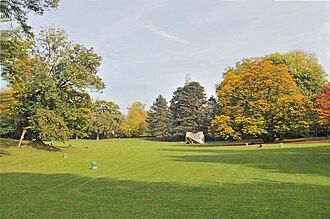 Urban
UrbanThe Municipal Park (French: parc de la Ville) is a public urban park in Luxembourg City, in southern Luxembourg. The eastern edge flanks the boulevard du Prince Henri and, along with the valleys of the Alzette and Pétrusse, forms a boundary that separates the central Ville Haute quarter from the re…
Read on Wikipedia Cultural
The Luxembourg City History Museum, French: Musée d'histoire de la Ville de Luxembourg, illustrates the thousand-year history of the City of Luxembourg with both permanent and temporary exhibits. Founded on 22 June 1996, it was designed by Luxembourg architect Conny Lentz and Repérages, Paris.
Read on Wikipedia Cultural
The Villa Vauban is an art museum in Luxembourg City. Recently renovated and extended, it exhibits 18th- and 19th-century paintings acquired from private collections.
Read on Wikipedia Religious Site
Trinity Church (Luxembourgish: Dräifaltegkeetskierch), also known as the Protestant Church, has been used since 1817 for Protestant services in the city of Luxembourg. It is located on Rue de la Congrégation in the old town.
Read on Wikipedia Religious Site
The Catholic Archdiocese of Luxembourg (Latin: Archidioecesis Luxemburgensis) is an archdiocese of the Latin Rite of the Catholic Church in the Grand Duchy of Luxembourg, comprising the entire Grand Duchy. The diocese was founded in 1870, and it became an archdiocese in 1988.
Read on Wikipedia Cultural
The Conservatoire de Luxembourg is a conservatoire in Luxembourg City, in southern Luxembourg. The conservatoire was founded in 1906, after a private donation made possible its establishment, which had been mandated under a Grand Ducal decree issued in 1904.
Read on Wikipedia Milestones
Liberty Road (French La voie de la Liberté) is the commemorative way marking the route of the Allied forces from D-Day in June 1944.
Read on Wikipedia Urban
UrbanParc Merl (Luxemburgish Märeler Park) is an urban park in Luxembourg City, in southern Luxembourg.Despite its name, the park is not located in the quarter of Merl, but in Hollerich.
Read on Wikipedia Museum
The Hospice Saint-Jean was a hospice in the rue Münster in the Grund district of Luxembourg City. Only city citizens were admitted.In 1997, the National Museum of Natural History opened its doors in these buildings.The origins go back to the year 1308, when Count Henry VII and his wife Margaret of…
Read on Wikipedia Fortifications
The Fortress of Luxembourg is the former fortifications of Luxembourg City, the capital of the Grand Duchy of Luxembourg, which were mostly dismantled beginning in 1867.
Read on Wikipedia Other
OtherThe Codex Mariendalenis is a manuscript on vellum containing the epic poem Yolanda vu Veianen or Yolanda of Vianden. It is believed to be the work of Brother Hermann von Veldenz who probably wrote the story of Yolanda's life in 1290 after her death in 1283.
Read on Wikipedia Historic architecture
Villa Louvigny is a building in Luxembourg City, in southern Luxembourg, that served as the headquarters of Compagnie Luxembourgeoise de Télédiffusion, the forerunner of RTL Group. It is located in Municipal Park, in the Ville Haute quarter of the centre of the city.
Read on Wikipedia Historic
The Monument of Remembrance (French: Monument du souvenir), usually known by the nickname of the Gëlle Fra (Luxembourgish for 'Golden Lady'), is a war memorial in Luxembourg City.
Read on Wikipedia Railway stations
Luxembourg railway station (Luxembourgish: Gare Lëtzebuerg, French: Gare de Luxembourg, German: Bahnhof Luxemburg) is the main railway station serving Luxembourg City, in southern Luxembourg.
Read on Wikipedia Entertainment
Théâtre d’Esch is a theatre in Esch-sur-Alzette, Luxembourg. Directed by Carole Lorang, the main auditorium has 517 numbered seats.
Read on Wikipedia Historic
Dalheim Ricciacum is the site of a Gallo-Roman vicus at Dalheim in south eastern Grand Duchy of Luxembourg. Founded during the reign of the Emperor Augustus, the site was at a strategic point on the Via Agrippa, the main Roman road from the Mediterranean to the Rhine.
Read on Wikipedia Fortifications
Bettembourg Castle (French: Château de Bettembourg) located in the centre of Bettembourg in the south of Luxembourg has a history starting in 1733 when it was built as the residence of a farming family.
Read on Wikipedia Palaces
Walferdange Castle (French: Château de Walferdange), located in the small town of Walferdange in central Luxembourg, dates from 1824 when William I of the Netherlands who was also Grand Duke of Luxembourg built it as a stud farm.
Read on Wikipedia Historic
Mamer (Luxembourgish pronunciation: [ˈmaːmɐ]) is a commune and town (strictly classified as a village) in south-western Luxembourg. It is located 7 km (4.3 mi) west of Luxembourg City. The commune includes Mamer itself, and also the smaller communities of Capellen and Holzem.
Read on Wikipedia Cemeteries
The Sandweiler German war cemetery is a World War II cemetery in Sandweiler, in southern Luxembourg. It contains the graves of 10,913 German servicemen from the Battle of the Bulge in winter 1944 and spring 1945.
Read on Wikipedia Architecture
Schauwenburg Castle (French: Château Schauenburg) in Bertrange in south-western Luxembourg has a history dating back to the Middle Ages when, according to historical references from the early 13th century, the Lords of Bertrange occupied a fortified castle.
Read on Wikipedia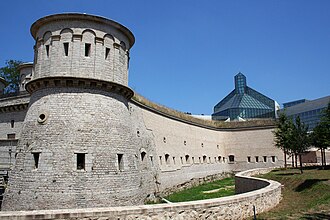 Cultural
The Grand Duke Jean Museum of Modern Art (French: Musée d'art moderne Grand-Duc Jean), abbreviated to Mudam, is a museum of modern art in Luxembourg City, in southern Luxembourg.
Read on Wikipedia Cultural
Musée Dräi Eechelen (literal translation: Three Acorns Museum) is a museum in the Kirchberg district of Luxembourg City in the Grand Duchy of Luxembourg. Opened in July 2012 in the fully restored 18th-century Fort Thüngen, its permanent exhibition traces Luxembourg's history from 1443 to 1903.
Read on Wikipedia Cemeteries
The Clausen German war cemetery (Deutscher Soldatenfriedhof Clausen in German) is a German military cemetery in Luxembourg City.
Read on Wikipedia Bridge
The Pulvermuhl Viaduct (Biisser Bréck in Luxemburgish) is a two-track railway viaduct in Pulvermuhl in eastern Luxembourg City, in southern Luxembourg.The viaduct crosses the Alzette valley between the north exit of the Luxembourg station and the Rham Plateau.
Read on Wikipedia Religious Site
Saint Michael's Church (Luxembourgish: Méchelskierch, French: Église Saint-Michel, German: Sankt Michaelskirche) is a Roman Catholic church in Luxembourg City, in southern Luxembourg. It is located in Fishmarket, in the central Ville Haute quarter.
Read on Wikipedia Bridge
The Passerelle, also known as the Luxembourg Viaduct, is a viaduct in Luxembourg City, in southern Luxembourg. Nowadays it runs from the south into the city centre, Ville Haute, carrying road traffic across the Pétrusse valley and connecting Avenue de la Gare to Boulevard Franklin Delano Roosevelt.…
Read on Wikipedia Architecture
The Lambert Redoubt is part of a seventeenth-century fort in the Municipal Park, Luxembourg City. The fort was destroyed by demolition in between 1868 and 1874, and the redoubt wasn't discovered until the city was excavating for the Monterey underground car park.The structure can be viewed from abov…
Read on WikipediaVille Haute (Luxembourgish: Uewerstad, German: Oberstadt) is a quarter in central Luxembourg City, in southern Luxembourg. It is the historic center of Luxembourg City and is involved in its UNESCO World Heritage Site status.
Read on WikipediaThe Raschpëtzer Qanat is located NE of Helmsange in the commune of Walferdange, 10 km north of the City of Luxembourg. A qanat is an underground water management system consisting of vertical shafts connecting to a sloping tunnel designed to provide a supply of fresh water.The Raschpëtzer is a par…
Read on WikipediaLuxembourg, officially the Grand Duchy of Luxembourg, is a landlocked country in Western Europe. It is bordered by Belgium to the west and north, Germany to the east, and France to the south and west. Its capital and most populous city, Luxembourg City, is one of the four institutional seats of the European Union and hosts several EU institutions, notably the Court of Justice of the European Union, the highest judicial authority in the EU.
Read on WikipediaStay connected with an affordable eSIM plan — instant activation, no roaming fees.
View eSIM Plans for LuxembourgAttraction data from OpenTripMap & OpenStreetMap