
 Architecture
Forum of Trajan
Forum of Trajan
Trajan's Forum (Latin: Forum Traiani; Italian: Foro di Traiano) was the last of the Imperial fora to be constructed in ancient Rome.
Read on Wikipedia
Discover the most popular attractions, landmarks, and must-visit places in Italy.
47 places to visit
ArchitectureTrajan's Forum (Latin: Forum Traiani; Italian: Foro di Traiano) was the last of the Imperial fora to be constructed in ancient Rome.
Read on Wikipedia Cultural
 Other
OtherThe Biblioteca Angelica (English: Angelica Library) is a public library located in Rome, Italy. In front of the Piazza Sant'Agostino square, adjacent to the church of Sant'Agostino, not far from Piazza Navona.The library holds about 180,000 volumes of manuscripts (among them Codex Angelicus) and 1,1…
Read on Wikipedia Religious Site
The Basilica of St. Augustine in Campo Marzio (Italian: Basilica di Sant'Agostino in Campo Marzio; Latin: Basilica Sancti Augustini in Campo Martio), commonly known as Basilica of St.
Read on Wikipedia Palaces
The Palazzo Venezia (Italian: [paˈlattso veˈnɛttsja]), formerly Palace of St. Mark, is a palazzo (palace) in central Rome, Italy, just north of the Capitoline Hill.
Read on Wikipedia Palaces
Palazzo Altieri is a palace in Rome, which was the home of the Altieri family in the city. The palace faces the square in front of the Church of the Gesù.The Altieri were one of the prominent families in Rome claiming descendancy from Roman nobility, and included Pope Clement X (reigned 1670-1676).
Read on Wikipedia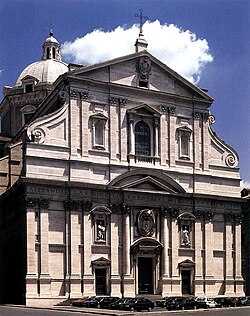 Religious Site
The Church of the Gesù (Italian: Chiesa del Gesù, pronounced [ˈkjɛːza del dʒeˈzu]) is the mother church of the Society of Jesus (Jesuits), a Catholic religious order.
Read on Wikipedia Religious Site
Santa Caterina a Magnanapoli is a baroque church dedicated to St. Catherine of Siena on Largo Magnanapoli on the slopes of the Quirinal Hill in Rome.A group of Dominican tertiary nuns, living in a small house in via Santa Chiara where St. Catherine had died, were looking for larger premises.
Read on Wikipedia Palaces
Palazzo Koch is a Renaissance Revival palace on Via Nazionale in Rome, Italy and the current head office of the nation's central bank, the Banca d'Italia.
Read on Wikipedia Religious Site
The Basilica of St. Mary of the Altar of Heaven (Latin: Basilica Sanctae Mariae de Ara coeli in Capitolio, Italian: Basilica di Santa Maria in Ara coeli al Campidoglio) is a titular basilica in Rome, located on the highest summit of the Campidoglio.
Read on Wikipedia Cultural
Museo Barracco di Scultura Antica (Italian, Barracco Museum of Antique Sculpture) is a museum in Rome, Italy, featuring a collection of works acquired by the collector Giovanni Barracco, who donated his collection to the City of Rome in 1902.Among the works are Egyptian, Assyrian, and Phoenician art…
Read on Wikipedia Religious Site
San Rocco is a church at 1 Largo San Rocco, Rome, dedicated to Saint Roch. It is next to the Mausoleum of Augustus.Founded in 1499 by Pope Alexander VI as the chapel of an adjacent hospital, it was rebuilt in 1657 to a design by Giovan Antonio de' Rossi, and later changes were made introducing the N…
Read on Wikipedia Palaces
Palazzo Braschi [paˈlat.tso ˈbras.ki] is a large Neoclassical palace in Rome, Italy and is located between the Piazza Navona, the Campo de' Fiori, the Corso Vittorio Emanuele II and the Piazza di Pasquino.
Read on Wikipedia Religious Site
Natività di Gesù is a church on Piazza Pasquino in the Parione rione of Rome. It is the national church in Rome of the Democratic Republic of Congo.It was built at the end of the 17th century for the Archconfraternity of the Company of the Nativity (known as the Agonizzanti), formed in 1616.
Read on Wikipedia Architecture
The Victor Emmanuel II National Monument (Italian: Monumento Nazionale a Vittorio Emanuele II), also known as the Mole del Vittoriano or simply Vittoriano, is a large national monument built between 1885 and 1935 to honour Victor Emmanuel II, the first king of a unified Italy, in Rome, Italy.
Read on Wikipedia Palaces
The Palazzo Massimo alle Colonne is a Renaissance palace in Rome, Italy. The palace was designed by Baldassarre Peruzzi in 1532–1536 on a site of three contiguous palaces owned by the old Roman Massimo family and built after arson destroyed the earlier structures during the Sack of Rome (1527).
Read on Wikipedia Religious Site
Sant'Ambrogio e Carlo al Corso (usually known simply as San Carlo al Corso) is a basilica church in Rome, Italy, facing onto the central part of the Via del Corso.
Read on Wikipedia Palaces
Palazzo Valentini is a palazzo in central Rome, Italy, not far from Piazza Venezia. Since 1873 it has been the base of the provincial and prefectural administration of Rome.
Read on Wikipedia Palaces
The Palazzo della Consulta (built 1732–1735) is a late Baroque palace in central Rome, Italy, that since 1955 houses the Constitutional Court of the Italian Republic. It sits across the Piazza del Quirinale from the official residence of the President of the Italian Republic, the Quirinal Palace.
Read on Wikipedia Cultural
The Teatro Valle (literally Valley Theater) is a theatre and former opera house in Rome, Italy. It was built in 1726 for the Capranica family. In the middle of the 19th century, it switched from staging opera and theatre to only performances of spoken drama.
Read on Wikipedia Religious Site
Sant'Andrea delle Fratte ("Saint Andrew of the Thickets") is a 17th-century basilica church in Rome, Italy, dedicated to St. Andrew. The Cardinal Priest of the Titulus S. Andreae Apostoli de Hortis is Ennio Antonelli.
Read on Wikipedia Palaces
Palazzo Madama (Italian pronunciation: [paˈlattso maˈdaːma]) in Rome is the seat of the Senate of the Italian Republic.It was built atop the ruins of the ancient baths of Nero, next to Piazza Navona.
Read on Wikipedia Palaces
The Quirinal Palace (Italian: Palazzo del Quirinale [paˈlattso del kwiriˈnaːle]) is a historic building in Rome, Italy, one of the three current official residences of the President of the Italian Republic, together with Villa Rosebery in Naples and the Tenuta di Castelporziano, an estate on the…
Read on Wikipedia Religious Site
The church of Saint Anthony in Campo Marzio, known as Saint Anthony of the Portuguese (Italian: Sant'Antonio dei Portoghesi, Portuguese: Santo António dos Portugueses), is a Baroque Roman Catholic titular church in Rome, dedicated to Saint Anthony of Lisbon.
Read on Wikipedia Religious Site
Sant'Eustachio [santeuˈstaːkjo] is a Roman Catholic titular church and minor basilica in Rome, named for the martyr Saint Eustace.
Read on Wikipedia Palaces
Palazzo Baldassini is a palace in Rome, Italy, designed by the Renaissance architect Antonio da Sangallo the Younger in about 1516–1519. It was designed for the papal jurist from Naples, Melchiorre Baldassini.
Read on Wikipedia Religious Site
The Minor Basilica of St. Lawrence in Lucina (Italian: Basilica Minore di San Lorenzo in Lucina or simply Italian: San Lorenzo in Lucina; Latin: S. Laurentii in Lucina) is a Roman Catholic parish, titular church, and minor basilica in central Rome, Italy.
Read on Wikipedia Religious Site
Santa Croce e San Bonaventura alla Pilotta or Santa Croce e di San Bonaventura dei Lucchesi is a church in Rome, sited on via dei Lucchesi in the Trevi district, between the Trevi Fountain and the Pontificia Università Gregoriana. It is Lucca's regional church in Rome.
Read on Wikipedia Religious Site
The Basilica of Saint Sylvester the First, also known as (Italian: San Silvestro in Capite, Latin: Sancti Silvestri in Capite), is a Roman Catholic minor basilica and titular church in Rome dedicated to Pope Sylvester I (d. AD 335).
Read on Wikipedia Religious Site
Santi Dodici Apostoli (Church of the Twelve Holy Apostles; Latin: SS. Duodecim Apostolorum), commonly known simply as Santi Apostoli, is a 6th-century Roman Catholic parish and titular church and minor basilica in Rome, Italy, dedicated originally to St. James and St.
Read on Wikipedia Cultural
The Accademia di San Luca, (the "Academy of Saint Luke") was founded in 1577 as an association of artists in Rome (under the directorship of Federico Zuccari from 1593), with the purpose of elevating the work of "artists", which included painters, sculptors and architects, above that of mere craftsm…
Read on Wikipedia Palaces
The Roman College (Latin: Collegium Romanum, Italian: Collegio Romano) was a school established by St. Ignatius of Loyola in 1551, just 11 years after he founded the Society of Jesus (Jesuits).
Read on Wikipedia Religious Site
Santa Maria in Aquiro is a church in Rome, Italy. It is dedicated to Mary, mother of Jesus, and is located on Piazza Capranica.
Read on Wikipedia Religious Site
The Church of St. Ignatius of Loyola at Campus Martius (Italian: Chiesa di Sant'Ignazio di Loyola in Campo Marzio, Latin: Ecclesia Sancti Ignatii a Loyola in Campo Martio) is a Roman Catholic titular church, of deaconry rank, dedicated to Ignatius of Loyola, the founder of the Society of Jesus, loca…
Read on Wikipedia Palaces
The Chigi Palace (Italian: Palazzo Chigi [paˈlattso ˈkiːdʒi]) is a palace and former noble residence in Rome which is the seat of the Council of Ministers and the official residence of the Prime Minister of Italy.
Read on Wikipedia Religious Site
San Macuto is a Roman Catholic church located on Piazza di San Macuto in the Colonna rione of Rome, Italy. Located next to the Jesuit Collegio di San Roberto Bellarmino in the Palazzo Gabrielli-Borromeo, it is the only church in Italy dedicated to the 7th century Breton saint Malo (Latin: Maclovius…
Read on Wikipedia Religious Site
The Temple of Neptune (Latin: Aedes Neptuni) was an ancient Roman temple dedicated to Neptune on the Campus Martius near the Circus Flaminius in Rome.
Read on Wikipedia Architecture
Trajan's Market (Latin: Mercatus Traiani; Italian: Mercati di Traiano) is a large complex of ruins in the city of Rome, Italy, located on the Via dei Fori Imperiali, at the opposite end to the Colosseum.
Read on Wikipedia Religious Site
Santissimo Sudario all'Argentina ([Church of] the Most Holy Shroud at the Argentina) or Santissimo Sudario dei Piemontesi (Church of the Most Holy Shroud of the Piedmontese) is a church in Rome, sited on the via del Sudario in the Sant'Eustachio district.
Read on Wikipedia Religious Site
Santa Maria in Monterone is a Roman Catholic church in Rome, Italy. Its suffix originates from the Sienese Monteroni family, whose patronage rebuilt the church and built a small hospice next to it for pilgrims from Siena. It is located on Via Santa Maria in Monterone in the Sant'Eustachio rione.
Read on Wikipedia Historic
The Via Salaria was an ancient Roman road in Italy.It eventually ran from Rome (from Porta Salaria of the Aurelian Walls) to Castrum Truentinum (Porto d'Ascoli) on the Adriatic coast, a distance of 242 km.
Read on Wikipedia Religious Site
The Church of Saint Andrew on the Quirinal (Italian: Sant'Andrea al Quirinale, Latin: S. Andreae in Quirinali) is a Roman Catholic titular church in Rome, Italy, built for the Jesuit seminary on the Quirinal Hill.The church of Sant'Andrea, an important example of Roman Baroque architecture, was desi…
Read on Wikipedia Palaces
The Palazzo della Cancelleria (Palace of the Chancellery, referring to the former Apostolic Chancery of the Pope) is a Renaissance palace in Rome, Italy, situated between the present Corso Vittorio Emanuele II and the Campo de' Fiori, in the rione of Parione.
Read on Wikipedia Religious Site
Santa Barbara dei Librai is a small Roman Catholic church in Rome, Italy. It was once known as Santa Barbara alla Regola after the rione in which it was located. Today it now considered within the rione of Parione, near the Campo de' Fiori.
Read on Wikipedia Religious Site
The Church of the Most Holy Name of Mary at the Trajan Forum (Italian: Santissimo Nome di Maria al Foro Traiano, Latin: Ss. Nominis Mariae ad forum Traiani) is a Roman Catholic church in Rome, Italy.
Read on Wikipedia Historic
The Fontana dei Dioscuri is the fountain set opposite the Palazzo del Quirinale, the official residence of the President of the Italian Republic in the Piazza del Quirinale.The original fountain, which no longer exists, commissioned by Pope Sixtus V in 1588, had the Dioscuri, Castor and Pollux statu…
Read on Wikipedia Religious Site
The Oratory of San Francesco Saverio del Caravita (St. Francis Xavier “del Caravita”) is a 17th-century baroque oratory in Rome, near the Church of Sant’Ignazio in rione Pigna.
Read on WikipediaItaly, officially the Italian Republic, is a country in Southern and Western Europe. It consists of a peninsula, which extends into the Mediterranean Sea, with the Alps on its northern land border, as well as nearly 800 islands, notably Sicily and Sardinia. Italy shares land borders with France to the west; Switzerland and Austria to the north; Slovenia to the east; and the two enclaves of Vatican City and San Marino.
Read on WikipediaStay connected with an affordable eSIM plan — instant activation, no roaming fees.
View eSIM Plans for ItalyAttraction data from OpenTripMap & OpenStreetMap