
 Cultural
Jeanie Johnston
Jeanie Johnston
Jeanie Johnston is a replica of a three masted barque that was originally built in Quebec, Canada, in 1847 by the Scottish-born shipbuilder John Munn.
Read on Wikipedia
Discover the most popular attractions, landmarks, and must-visit places in Ireland.
96 places to visit
CulturalJeanie Johnston is a replica of a three masted barque that was originally built in Quebec, Canada, in 1847 by the Scottish-born shipbuilder John Munn.
Read on Wikipedia Bridge
Seán O'Casey Bridge (Irish: Droichead Sheáin Uí Chathasaigh) is a pedestrian swingbridge spanning the River Liffey in Dublin, joining City Quay in the Grand Canal Docks area to North Wall Quay and the IFSC.
Read on Wikipedia Religious Site
St. Peter's Church was a former Church of Ireland parish church located in Aungier Street in Dublin, Ireland, where the Dublin YMCA building now stands. It was built on land that formerly belonged to the Whitefriars in Dublin. It served the largest Church of Ireland parish in Dublin.
Read on Wikipedia Entertainment
The Queen's Theatre, Dublin, located in Pearse Street was originally built in 1829 as the Adelphi Theatre. This building was demolished in 1844 and rebuilt. It reopened that same year as the Queens Royal Theatre, the new owner having been granted a Royal Patent to operate as a patent theatre.
Read on Wikipedia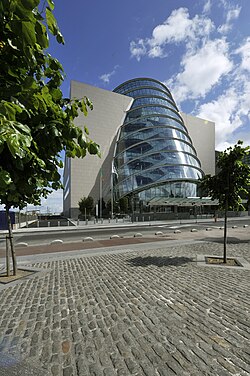 Other
OtherThe Convention Centre Dublin (Irish: Ionad Comhdhála, Baile Átha Cliath) is a convention centre in the Dublin Docklands, Ireland. The Convention centre overlooks the River Liffey at Spencer Dock. It was designed by the Irish-born American architect Kevin Roche.
Read on Wikipedia Historic
Robert Emmet (4 March 1778 – 20 September 1803) was an Irish Republican, orator and rebel leader. Following the suppression of the United Irish uprising in 1798, he sought to organise a renewed attempt to overthrow the British Crown and Protestant Ascendancy in Ireland, and to establish a national…
Read on Wikipedia Cultural
Luke Kelly (17 November 1940 – 30 January 1984) was an Irish singer, folk musician and actor from Dublin, Ireland. Born into a working-class household in Dublin city, Kelly moved to England in his late teens and by his early 20s had become involved in a folk music revival.
Read on Wikipedia Cultural
The Douglas Hyde Gallery is a publicly funded contemporary art gallery situated within the historical setting of Trinity College in Dublin, Ireland.When the Gallery opened in 1978, it was for a number of years Ireland's only public gallery of contemporary art.
Read on Wikipedia Cultural
Sphere Within Sphere (Sfera con sfera) is a bronze sculpture by Italian sculptor Arnaldo Pomodoro.Versions of the sculpture (diameters vary) can be seen in many settings worldwide, including:United Nations Art Collection List of public art in Washington, D.C., Ward 2flickr.com
Read on Wikipedia Other
OtherTrinity College (Irish: Coláiste na Tríonóide), officially the College of the Holy and Undivided Trinity of Queen Elizabeth near Dublin, is the sole constituent college of the University of Dublin, a research university in Dublin, Ireland.
Read on Wikipedia Other
OtherThe Mansion House (Irish: Teach an Ard-Mhéara) on Dawson Street, Dublin, has been the official residence of the Lord Mayor of Dublin since 1715, and was also the meeting place of the Dáil Éireann from 1919 until 1922.The Mansion House was built in 1710 by the merchant and property developer Joshu…
Read on Wikipedia Museum
The State Heraldic Museum in Kildare Street, Dublin, was founded in 1909 and was prior to its closure one of the first and oldest such museums in the world.
Read on Wikipedia Bridge
The Tom Clarke Bridge (Irish: Droichead Thomáis Uí Chléirigh), formerly and commonly known as the East-Link Toll Bridge, is a toll bridge in Dublin, Ireland, on the River Liffey, owned and operated by Dublin City Council.
Read on Wikipedia Cultural
The Little Museum of Dublin is a local history museum situated at St. Stephens Green, Dublin, Ireland. The museum is located in an 18th-century Georgian townhouse owned by Dublin City Council.
Read on Wikipedia Religious Site
St. Kevin's Church opened in Harrington St., Dublin, in 1872 to serve the Roman Catholic parish of St. Kevin, which had been split from St. Catherine's in 1865. It was named after the nearby St.
Read on Wikipedia Cultural
The Irish Jewish Museum (Irish: Músaem Giúdach na hÉireann) is a small museum located in the once highly Jewish populated area of Portobello, around the South Circular Road, Dublin 8, dedicated to the history of the Irish Jewish community.
Read on Wikipedia Urban
UrbanIrishtown Nature Park is a small man-made park between Irishtown and Sandymount Strand in Dublin 4, Ireland that offers several kilometres of walking trails along the Poolbeg Peninsula.The park was devised during a building boom in the 1970s, where rubble and waste was dumped in its current location…
Read on Wikipedia Nature
Sandymount Strand (Irish: Dumhach Thrá) is a large strand on the east coast of Ireland, adjacent to the village and suburb of Sandymount in Dublin. It is part of South Bull - a major component of the south side of Dublin Bay, and part of the Dublin Bay Biosphere Reserve.
Read on Wikipedia Historic
 Cultural
The Gaiety Theatre is a theatre on South King Street in Dublin, Ireland, off Grafton Street and close to St. Stephen's Green. It specialises in operatic and musical productions, with occasional dramatic shows.
Read on Wikipedia Religious Site
There was a St. Kevin's Church (Irish: Eaglais Naomh Caoimhín) in what is now St. Kevin's Park, Camden Row, Dublin, Ireland at least as far as the 13th century. After the Reformation, it became an Anglican Church.
Read on Wikipedia Cultural
The 3Arena (originally The O2) is an indoor amphitheatre located at North Wall Quay in the Dublin Docklands in Dublin, Ireland. The venue opened as The O2 on 16 December 2008.
Read on Wikipedia Entertainment
The Point Theatre (sometimes referred to as the Point Depot or simply as the Point) was a concert and events venue in Dublin, Ireland, that operated from 1988 to 2007, visited by in excess of 2 million people. It was located on the North Wall Quay of the River Liffey, amongst the Dublin Docklands.
Read on Wikipedia Historic
Robert Noonan (17 April 1870 – 3 February 1911), born Robert Croker and best known by the pen name Robert Tressell, was an Irish writer best known for his novel The Ragged-Trousered Philanthropists.Tressell spent his entire early adult working life in South Africa.
Read on Wikipedia Religious Site
St. Andrew's Church is a Roman Catholic church located in Westland Row, Dublin, Republic of Ireland. Construction started in 1832, it opened for public worship in 1834 but was not completed until 1837.The architect appointed to design the church was John Bolger.
Read on Wikipedia National museums
The National Library of Ireland (NLI; Irish: Leabharlann Náisiúnta na hÉireann) is the Republic of Ireland's national library located in Dublin, in a building designed by Thomas Newenham Deane.
Read on WikipediaMuseumIrish Queer Archive (IQA) (Irish: Cartlann Aerach na hÉireann) is a comprehensive collection of material in Ireland relating to homosexuality, LGBT literature and general queer studies.
Read on Wikipedia Historic
Constance Georgine Markievicz (Polish: Markiewicz [marˈkʲɛvitʂ]; née Gore-Booth; 4 February 1868 – 15 July 1927), also known as Countess Markievicz and Madame Markievicz, was an Irish politician, revolutionary, nationalist, suffragist, socialist, and the first woman elected to the Westminster…
Read on Wikipedia National museums
The National Museum of Ireland – Archaeology (Irish: Ard-Mhúsaem na hÉireann - Seandálaíocht, often known as the "NMI") is a branch of the National Museum of Ireland located on Kildare Street in Dublin, Ireland, that specialises in Irish and other antiquities dating from the Stone Age to the L…
Read on Wikipedia National museums
The National Gallery of Ireland (Irish: Gailearaí Náisiúnta na hÉireann) houses the national collection of Irish and European art. It is located in the centre of Dublin with one entrance on Merrion Square, beside Leinster House, and another on Clare Street.
Read on Wikipedia Urban
UrbanSt Stephen's Green (Irish: Faiche Stiabhna) is a garden square and public park located in the city centre of Dublin, Ireland. The current landscape of the park was designed by William Sheppard. It was officially re-opened to the public on Tuesday, 27 July 1880 by Lord Ardilaun.
Read on Wikipedia Cultural
William Conyngham Plunket, 4th Baron Plunket (26 August 1828 – 1 April 1897) was Dean of Christ Church Cathedral and Archbishop of Dublin in the Church of Ireland.Born in Dublin, he was the eldest son of John Plunket, 3rd Baron Plunket and Charlotte Bushe.
Read on Wikipedia Palaces
Leinster House (Irish: Teach Laighean) is the seat of the Oireachtas, the parliament of Ireland.Leinster House was originally the ducal palace of the Dukes of Leinster.
Read on Wikipedia Cemeteries
The Huguenot Cemetery (Irish: Reilig na nÚgóineach, French: Cimetière huguenot de Dublin) is a small cemetery dating from 1693 located near St. Stephen's Green, Dublin, Ireland, beside the Shelbourne Hotel.
Read on Wikipedia Religious Site
Church of the Assumption, Booterstown is a Roman Catholic church located in Booterstown, County Dublin, Ireland. The church represents the Parish of the Assumption Booterstown, which was established in 1616.
Read on Wikipedia Cultural
The National Concert Hall (NCH) (An Ceoláras Náisiúnta) is a concert hall located on Earlsfort Terrace in Dublin, Ireland. It is a national cultural institution and the designated home of music in Ireland.
Read on Wikipedia Cultural
The Royal Hibernian Academy (RHA) is an artist-based and artist-oriented institution in Ireland, founded in Dublin in 1823. Like many other Irish institutions, such as the RIA, the academy retained the word "Royal", after Ireland's independence.
Read on Wikipedia Historic
Koizumi Yakumo (小泉 八雲, 27 June 1850 – 26 September 1904), born Patrick Lafcadio Hearn (; Greek: Πατρίκιος Λευκάδιος Χερν), was a writer of Greek-Irish descent, born in Greece, who in his forties found a literal and spiritual home in Japan.
Read on Wikipedia Cinemas
The Irish Film Theatre (IFT) was a cinema dedicated to showing art films in Dublin in Ireland from 1977 to 1984.The Arts Council of Ireland established Irish Film Theatre Limited as a company to promote the art of cinema in Ireland.
Read on Wikipedia Religious Site
St. Patrick's Church is a Roman Catholic church in Ringsend, Dublin.
Read on Wikipedia Religious Site
Mary Immaculate, Refuge of Sinners is a Roman Catholic church in Rathmines, Dublin. The church was originally designed by Patrick Byrne and later extended by William Henry Byrne who added a portico and pediment.The church was destroyed in January 1920 by a fire but was rebuilt and reopened by 1922.r…
Read on Wikipedia Cultural
The Irish Architectural Archive was established in 1976 by Dr Edward McParland and Nicholas Robinson as the National Trust Archive. Its objective is to collect and preserve material of every kind relating to the architecture of Ireland, and make it available to the public.
Read on Wikipedia Cultural
Number Twenty Nine: Georgian House Museum is a preserved Georgian townhouse in Dublin. The house is furnished to show how it would have looked during the period of 1790 to 1820.
Read on Wikipedia Religious Site
The Islamic Cultural Centre of Ireland (ICCI; Irish: Ionad Cultúrtha Ioslamach na hÉireann) is an Islamic complex, including a mosque, in Clonskeagh, Dublin, Ireland. It is funded by the al-Maktoum Foundation of Dubai and has a Sunni orientation.
Read on Wikipedia Fortifications
Baggotrath Castle, or Baggotsrath Castle, was a castle situated at present-day Baggot Street in Dublin city centre. It was built in the late thirteenth century by the Bagod (later called Baggot) family, for whom it was named.
Read on Wikipedia National museums
The National Print Museum in Beggar's Bush, Dublin, Ireland, collects, and exhibits a representative selection of printing equipment, and samples of print, and fosters associated skills of the printing craft in Ireland.
Read on Wikipedia Sport
SportLansdowne Road Stadium (Irish: Bóthar Lansdún, IPA: [ˈbˠoːhəɾˠ ˈl̪ˠan̪ˠsˠd̪ˠuːn̪ˠ]) was a stadium in Dublin owned by the Irish Rugby Football Union (IRFU) that was primarily used for rugby union and association football matches.
Read on Wikipedia Historic
Eoin MacNeill (Irish: Eoin Mac Néill; born John MacNeill; 15 May 1867 – 15 October 1945) was an Irish scholar, Irish language enthusiast, Gaelic revivalist, nationalist, and politician who served as Minister for Education from 1922 to 1925, Ceann Comhairle of Dáil Éireann from 1921 to 1922, Min…
Read on Wikipedia Cemeteries
Donnybrook Cemetery (Irish: Reilig Dhomhnach Broc) is located close to the River Dodder in Donnybrook, Dublin, Ireland. The cemetery was the location of an old Celtic church founded by Saint Broc and later a church dedicated to St. Mary.
Read on Wikipedia Historic
Thomas Osborne Davis (14 October 1814 – 16 September 1845) was an Irish writer; with Charles Gavan Duffy and John Blake Dillon, a founding editor of The Nation, the weekly organ of what came to be known as the Young Ireland movement.
Read on Wikipedia Historic
Kilmashogue or Kilmashoge (Irish: Cill Mochióg) is a mountain in Dún Laoghaire–Rathdown county in Ireland. It is 408 metres (1,339 feet) high and forms part of the group of hills in the Dublin Mountains which comprises Two Rock, Three Rock, Kilmashogue and Tibradden Mountains.
Read on Wikipedia Religious Site
Kill of the Grange is an ancient parish in the half Barony of Rathdown, which contains an ancient religious site in County Dublin, Ireland and a National Monument. it is 5 miles south east of Dublin.Kill of the Grange lies 1.7 km (1.1 mi) inland, on the south side of Dublin Bay.
Read on Wikipedia Architecture
The Casino at Marino is a summer or pleasure house, located in Marino, Dublin, Ireland. Sometimes erroneously described as a folly, it was designed by Scottish architect William Chambers for James Caulfeild, the 1st Earl of Charlemont, starting in the late 1750s and finishing around 1775.
Read on Wikipedia Architecture
Kilmainham Gaol (Irish: Príosún Chill Mhaighneann) is a former prison in Kilmainham, Dublin, Ireland. It is now a museum run by the Office of Public Works, an agency of the Government of Ireland.
Read on Wikipedia Architecture
Rathfarnham Castle (Irish: Caisleán Rath Fearnáin) is a 16th-century fortified house in Rathfarnham, South Dublin, Ireland.
Read on Wikipedia Religious Site
St. Mary's Abbey was a former Cistercian abbey located near Abbey Street in Dublin, Ireland. Its territory stretched from the district known as Oxmanstown down along the River Liffey until it met the sea. It also owned large estates in other parts of Ireland.
Read on Wikipedia Religious Site
St Audoen's Church () is the church of the parish of Saint Audoen in the Church of Ireland, located south of the River Liffey at Cornmarket in Dublin, Ireland. This was close to the centre of the medieval city. The parish is in the Diocese of Dublin and Glendalough.
Read on Wikipedia Other
OtherThe Book of Kells (Latin: Codex Cenannensis; Irish: Leabhar Cheanannais; Dublin, Trinity College Library, MS A. I. [58], sometimes known as the Book of Columba) is an illuminated manuscript Gospel book in Latin, containing the four Gospels of the New Testament together with various prefatory texts a…
Read on Wikipedia Mountain peaks
Montpelier Hill (Irish: Cnoc Mount Pelier) is a 383 metres (1,257 foot) hill in County Dublin, Ireland. It is commonly referred to as the Hell Fire Club (Irish: Club Thine Ifreann), the popular name given to the ruined building at the summit believed to be one of the first Freemason lodges in Irelan…
Read on Wikipedia Fortifications
Manderley Castle (Irish: Caisleán Mhanderley), formerly "Victoria Castle" and "Ayesha Castle", is a large castellated Irish mansion built in Victorian style, in Killiney, County Dún Laoghaire–Rathdown, Ireland.
Read on Wikipedia Historic
The Irish National War Memorial Gardens (Irish: Gairdíní Náisiúnta Cuimhneacháin Cogaidh na hÉireann) is an Irish war memorial in Islandbridge, Dublin, dedicated "to the memory of the 49,400 Irish soldiers who gave their lives in the Great War, 1914–1918", out of a total of 206,000 Irishmen…
Read on Wikipedia Cemeteries
Carrickbrennan Churchyard (Irish: Reilig Charraig Bhraonáin) located on Carrickbrennan Road, Monkstown, County Dublin, Ireland is a graveyard that can still be seen today, but is no longer in use. It is notable as the burial place of many people who perished in local maritime disasters.
Read on Wikipedia Religious Site
Manresa House is a retreat centre run by the Society of Jesus in the Dollymount area of Clontarf in Dublin, near Saint Anne's Park. In the 19th century it was home to Robert Warren and Arthur Guinness, and it is a protected structure.
Read on Wikipedia Cemeteries
Goldenbridge Cemetery (Irish: Reilig an Droichid Órga) is a Roman Catholic garden cemetery located in Inchicore, Dublin, Ireland.Under the Penal Laws, Irish Catholics could only be buried in Church of Ireland (Anglican) cemeteries, and the full graveside rites could not be performed — only prayer…
Read on Wikipedia Bridge
Seán Heuston Bridge (Irish: Droichead Seán Heuston) is a cast-iron bridge spanning the River Liffey beside Heuston Station, Dublin.
Read on Wikipedia Historic
Ludwig Josef Johann Wittgenstein ( VIT-gən-s(h)tyne; German: [ˈluːtvɪç joˈhan ˈjoːzɛf ˈvɪtɡn̩ʃtaɪn]; 26 April 1889 – 29 April 1951) was an Austrian-British philosopher who worked primarily in logic, the philosophy of mathematics, the philosophy of mind, and the philosophy of languag…
Read on Wikipedia Historic
Anna Livia is a bronze monument located in Croppies' Acre Memorial Park in Dublin, Ireland. It was formerly located on O'Connell Street.Designed by the sculptor Éamonn O'Doherty, the monument was commissioned by businessman Michael Smurfit, in memory of his father, for the Dublin Millennium celebra…
Read on Wikipedia National museums
The National Museum of Ireland – Decorative Arts and History (Irish: Ard-Mhúsaem na hÉireann – Na hEalaíona Maisiúla ⁊ Stair) is a branch of the National Museum of Ireland (NMI) located at the former Collins Barracks in the Arbour Hill area of Dublin, Ireland.This museum holds historical a…
Read on Wikipedia Religious Site
St. Joseph's Carmelite Church on Berkeley Road, Dublin, Ireland is the Roman Catholic church of the Berkeley Road Parish. The church is dedicated to Saint Joseph and is in full use today in the care of the Discalced Carmelites.Originally a wooden chapel of ease was built here in 1870 until its repla…
Read on Wikipedia Urban
UrbanBlessington Street Basin (Irish: Báisín Shráid Bhaile Coimín) is a drinking water reservoir in Dublin which operated from 1810 until the 1970s, serving the north city. It became a public park in 1994.
Read on Wikipedia Park
ParkThe Croppies' Acre (Irish: Acra na gCraipithe), officially the Croppies Acre Memorial Park, is a public park in Dublin, Ireland.
Read on Wikipedia Cemeteries
Ballybough Cemetery (Irish: Reilig an Bhaile Bhoicht) is a Jewish cemetery in Ballybough, Dublin. Founded in 1718, it is Ireland's oldest Jewish cemetery.The cemetery is bounded on one side by a former Royal Irish Constabulary barracks (1830-1910).
Read on Wikipedia Religious Site
St. Joseph's Church is a Catholic church situated on Church Road in the East Wall area of Dublin, Ireland.Originally this area was part of St Laurence O'Toole Parish, North Wall, in the diocese of Dublin.
Read on Wikipedia Other
OtherThe General Post Office (GPO; Irish: Ard-Oifig an Phoist) in Dublin is the headquarters of An Post, the Irish Post Office, and Dublin's principal post office.
Read on Wikipedia Other
OtherMarsh's Library, situated in St. Patrick's Close, adjacent to St. Patrick's Cathedral, Dublin, Ireland is a well-preserved library of the late Renaissance and early Enlightenment. When it opened to the public in 1707 it was the first public library in Ireland.
Read on Wikipedia Cinemas
The Screen Cinema was a three-screen cinema in Hawkins Street, Dublin, Ireland.The cinema had been operating since 1984, showing world cinema, and independent and Irish films.
Read on Wikipedia Bridge
The Talbot Memorial Bridge (Irish: Droichead Cuimhneacháin an Talbóidigh) is a road bridge spanning the River Liffey in Dublin city centre in Ireland. Completed in 1978, it is 22 metres (72 feet) wide, and was designed by De Leuw, Chadwick and O’hEocha Consulting Engineers.
Read on Wikipedia Cultural
Kerlin Gallery is a contemporary commercial art gallery in Dublin, Ireland.Originally opened in 1988, the gallery's current space was designed in 1994 by architect John Pawson. It is located in central Dublin and has 3,600 square feet of gallery space spread over two floors.
Read on Wikipedia Science museums
Science Gallery is an international group of public science centres, developed from a concept by a group connected to Trinity College Dublin, Ireland.
Read on Wikipedia Historic
Humphrey Lloyd FRS FRSE MRIA (1800–1881) was an Irish physicist. He was Erasmus Smith's Professor of Natural and Experimental Philosophy at Trinity College Dublin (1831-1843) and much later Provost (1867–1881).
Read on Wikipedia Architecture
Fusiliers' Arch is a monument which forms part of the Grafton Street entrance to St Stephen's Green park, in Dublin, Ireland.
Read on Wikipedia Religious Site
St. Ann's Church, Dawson Street, in Dublin, Ireland, was built in the early 18th century following the establishment of the local Anglican parish in 1707.
Read on Wikipedia Other
OtherThe Royal Irish Academy (RIA; Irish: Acadamh Ríoga na hÉireann), based in Dublin, is an academic body that promotes study in the sciences, humanities and social sciences. It is one of Ireland's premier learned societies and cultural institutions.
Read on Wikipedia Cultural
The Bord Gáis Energy Theatre (originally the Grand Canal Theatre) is a performing arts venue, located in the Docklands of Dublin, Ireland. It is Ireland's largest fixed-seat theatre.
Read on Wikipedia Historic
The Bust of Cardinal Guido Bentivoglio is a marble sculpture by an unknown artist active in Rome in the 1630s. It was formerly attributed to the Flemish sculptor François Duquesnoy. It was realized after 1638, possibly around 1641, and is currently housed at the National Gallery of Ireland.
Read on Wikipedia Historic
George Bernard Shaw 26 July 1856 – 2 November 1950), known at his insistence simply as Bernard Shaw, was an Irish playwright, critic, polemicist and political activist. His influence on Western theatre, culture and politics extended from the 1880s to his death and beyond.
Read on Wikipedia Religious Site
The Church of Our Lady Seat of Wisdom, also known as Newman University Church or Catholic University Church, is a Catholic church in Dublin, Ireland.
Read on Wikipedia National museums
The National Museum of Ireland – Natural History (Irish: Ard-Mhúsaem na hÉireann – Stair an Dúlra), sometimes called the Dead Zoo, a branch of the National Museum of Ireland, is housed on Merrion Street in Dublin, Ireland.
Read on Wikipedia Cultural
William Dargan (28 February 1799 – 7 February 1867) was arguably the most important Irish engineer of the 19th century and certainly the most important figure in railway construction. Dargan designed and built Ireland's first railway line from Dublin to Dún Laoghaire in 1833.
Read on Wikipedia Historic
The Oscar Wilde Memorial Sculpture is a collection of three statues in Merrion Square in Dublin, Ireland, commemorating Irish poet and playwright Oscar Wilde. The sculptures were unveiled in 1997 and were designed and made by Danny Osborne.
Read on WikipediaNational museumsThe National Museum of Ireland (Irish: Ard-Mhúsaem na hÉireann) is Ireland's leading museum institution, with a strong emphasis on national and some international archaeology, Irish history, Irish art, culture, and natural history.
Read on WikipediaThe Augustinian Friary of the Most Holy Trinity was an Augustinian (Order of Saint Augustine (mendicants)) Roman Catholic Priory, founded c. 1259, by the family of Talbot on the south bank of the river, in what is now Crow Street, Dublin.
Read on WikipediaThe first bombing of Dublin in World War II occurred early on the morning of 2 January 1941, when German bombs were dropped on the Terenure area of south Dublin.
Read on WikipediaSt. Bride's Church was a Church of Ireland church located in Bride St., Dublin, Ireland. It was closed in 1898 and demolished to make way for social housing.The original St.
Read on WikipediaHavel's Place is a public art project, which creates a series of memorial places dedicated to the last president of Czechoslovakia and the first president of the Czech Republic, Václav Havel.
Read on WikipediaOver the centuries, there have been five theatres in Dublin called the Theatre Royal.In the history of the theatre in Great Britain and Ireland, the designation "Theatre Royal", or "Royal Theatre", once meant that a theatre had been granted a royal patent, without which "serious drama" theatrical pe…
Read on WikipediaIreland is an island in the North Atlantic Ocean, in Northwestern Europe. Geopolitically, the island is divided between the Republic of Ireland and Northern Ireland. It is separated from Great Britain to its east by the North Channel, the Irish Sea, and St George's Channel. Ireland is the second-largest island of the British Isles, the third-largest in Europe, and the twentieth-largest in the world.
Read on WikipediaStay connected with an affordable eSIM plan — instant activation, no roaming fees.
View eSIM Plans for IrelandAttraction data from OpenTripMap & OpenStreetMap