
 Religious Site
Imam Bukhari Memorial Complex
Entdecken Sie die beliebtesten Attraktionen, Wahrzeichen und Sehenswürdigkeiten in Tadschikistan.
41 Orte zu besuchen
Religious Site Religious Site
The St. John the Baptist Church (Russian: Церковь святого Иоанна Крестителя) It is the only Catholic church in the city of Samarkand, in the Asian country of Uzbekistan, where 95% are Muslims. It depends on the Apostolic Administration of Uzbekistan based in Tashkent.
Auf Wikipedia lesen Religious Site
The Bibi-Khanym Mosque (Uzbek: Bibi-Xonim masjidi; Persian: مسجد بی بی خانم; also variously spelled as Khanum, Khanom, Hanum, Hanim) is one of the most important monuments of Samarkand, Uzbekistan.
Auf Wikipedia lesen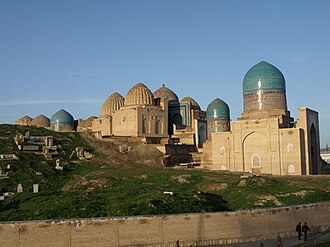 Cultural
Shah-i-Zinda (Uzbek: Shohizinda; Persian: شاه زنده, meaning "The Living King") is a necropolis in the north-eastern part of Samarkand, Uzbekistan.The Shah-i-Zinda Ensemble includes mausoleums and other ritual buildings of 11-15th and 19th centuries.
Auf Wikipedia lesen Mountain peaks
Kallat peak (Persian: کوه کلات) is one of the highest mountains located near Guzun village in Khwahan District in the North East of Afghanistan.
Auf Wikipedia lesen Nature
Ivan Vasilʹevich Mushketov (Russian: Иван Васильевич Мушкетов; 1850–1902) was a famous Russian geologist, tectonist, explorer, and geographer.Mushketov was born 9 (21 New Style) January 1850 in the Dango Cossack area of the Don region and entered Saint Petersburg University…
Auf Wikipedia lesen Settlements
Dalverzin Tepe is an ancient archaeological site located in the northern part of the region of Bactria, southern modern Uzbekistan, about 120 km north-east of Termez.It is the location of Hellenistic constructions made during the time of the Greco-Bactrians, perhaps a small fortress.
Auf Wikipedia lesen Historic
The Gūr-i Amīr or Guri Amir (Uzbek: Amir Temur maqbarasi, Go'ri Amir, Persian: گورِ امیر) is a mausoleum of the Turco-Mongol conqueror Timur (also known as Tamerlane) in Samarkand, Uzbekistan.
Auf Wikipedia lesen Historic
The Registan was the heart of the ancient city of Samarkand of the Timurid Empire, now in Uzbekistan. The name Rēgistan (ریگستان) means "sandy place" or "desert" in Persian.The Registan was a public square, where people gathered to hear royal proclamations, heralded by blasts on enormous cop…
Auf Wikipedia lesen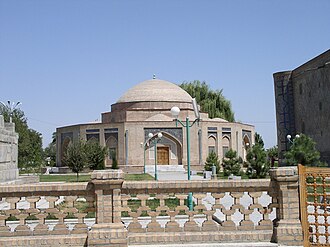 Cultural
Chorsu (Persian: چارسو, Uzbek: Chorsu and Russian: Чорсу), also called charsu, in Samarkand, Uzbekistan, is a domed, hexagonal building southeast of the Registan at the intersection of the roads connecting Samarkand, Tashkent, Bukhara, and Shahrisabz.
Auf Wikipedia lesen Cultural
Afrasiab Museum of Samarkand (Uzbek: Afrosiyob-Samarqand shahar tarixi muzeyi) is a museum located at the historical site of Afrasiyab, one of the largest archaeological sites in the world and the ancient city that was destroyed by the Mongols in the early 13th century.
Auf Wikipedia lesen Other
OtherThe Afghanistan–Uzbekistan Friendship Bridge is a road and rail bridge across the river Amu Darya, connecting the town of Hairatan in the northern Balkh province of Afghanistan with Termez in the Surxondaryo Region of Uzbekistan.
Auf Wikipedia lesen Fortifications
Tavka Kurgan is an ancient fortress and archaeological site near Shirabad, Uzbekistan. It is especially famous for some frescoes dated to the 5th-6th century CE, several of them located in the Archaeological Museum of Termez.
Auf Wikipedia lesen Bridge
The Tajikistan–Afghanistan Friendship Bridge connects the two banks of Darvaz region across the Panj River (further downstream known under the name Amu Darya) separating Tajikistan and Afghanistan, at the town of Qal'ai Khumb. It was opened on 6 July 2004.
Auf Wikipedia lesen Religious Site
Dor-i-Tilavat/Dorut Tilovat/Dor al-Tilavat (House of recitation) is a madrasa in Shahrisabz, Uzbekistan.
Auf Wikipedia lesen Historic
The Oxus treasure (Persian: گنجینه آمودریا) is a collection of about 180 surviving pieces of metalwork in gold and silver, most relatively small, and around 200 coins, from the Achaemenid Persian period which were found by the Oxus river about 1877–1880.
Auf Wikipedia lesen Historic
Ai-Khanoum (lit. “Lady Moon” in Uzbek) (Greek: Κυρία της Σελήνης), possibly the historical Eucratideia, was one of the primary cities and an enigma of the Greco-Bactrian Kingdom and of the Indo-Greek kings when they ruled both in Bactria and northwestern India, from the time of De…
Auf Wikipedia lesen Religious Site
The Dushanbe Synagogue (Russian: Душанбинская синагога), also known as the Bukharian Synagogue (Russian: Бухарская синагога), located in Dushanbe, the capital of Tajikistan, was constructed in the 19th century in one of the two Jewish Quarters in Dushanbe at the…
Auf Wikipedia lesen Palaces
The Palace of Unity (Russian: Кохи Вахдат; Tajik: Кохи Ваҳдат/Kokhi Vahdat/کاخ وحدت), also referred to as Vahdat Palace (Russian: Дворец Единства), is a building in Dushanbe, Tajikistan.
Auf Wikipedia lesen Religious Site
St. Nicholas Cathedral (Russian: Свято-Николаевский собор) is a Russian Orthodox church in Dushanbe, Tajikistan.
Auf Wikipedia lesen Religious Site
The Ismaili Centre, Dushanbe (Russian: Исмаилитский центр) is one of six such centres world-wide and is an Ismaili jamatkhana. It was the fifth purpose-built Ismaili Centre, and the first in Central Asia.
Auf Wikipedia lesen Urban
UrbanDushanbe Zoo or Dushanbe Zoological Park (Russian: Душанбинский зоопарк; Tajik: Боғи Ҳайвоноти Душанбе) was founded in 1960 in Dushanbe, Tajikistan.
Auf Wikipedia lesen Landmark
The Panj (Persian: رودخانه پنج) (; Tajik: Панҷ, پنج), traditionally known as the Ochus River and also known as Pyandzh or Pyanj (derived from its Russian name "Пяндж"), is a tributary of the Amu Darya.
Auf Wikipedia lesen Historic
Boysun (also spelt Baysun, Bajsun or Baisun) is a town in Surxondaryo Region, Uzbekistan and capital of Boysun District. The population as of the 1989 census was 16,700; an estimate for 2012 puts the population at 26,309.
Auf Wikipedia lesen Other
OtherThe Fann Mountains (Tajik: Кӯҳҳои Фон, Uzbek: Fon togʻlari) are part of the western Pamir-Alay mountain system in Tajikistan's Sughd Province, between the Zarafshan Range to the north and the Gissar Range to the south.
Auf Wikipedia lesen Historic
Sarazm is an ancient town and also a jamoat in north-western Tajikistan. It dates back to the 4th millennium BC and is today a UNESCO World Heritage Site. The jamoat is part of the city of Panjakent in Sughd Region, and has a total population of 27,877 (2015).
Auf Wikipedia lesen Historic
Panjakent (Tajik: Панҷакент), or Penjikent (Russian: Пенджикент) is a city in the Sughd province of Tajikistan on the river Zeravshan, with a population of 52,500 (2020 estimate). It was once an ancient town in Sogdiana.
Auf Wikipedia lesen Other
OtherThe Gissaro-Alai open woodlands ecoregion (WWF ID:PA0808) covers the western foothills winding around two western offshoots of the Tian Shan Mountains in western Tajikistan, and parts of eastern Uzbekistan and western Kyrgyzstan, in Central Asia.
Auf Wikipedia lesen Historic
Abū Ibrāhīm Ismā'īl ibn Aḥmad (Persian: ابو ابراهیم اسماعیل بن احمد سامانی; May 849 – 24 November 907), better known simply as Ismail Samani (اسماعیل سامانی), and also known as Isma'il ibn Ahmad (اسماعیل بن احمد), was the Samanid ami…
Auf Wikipedia lesenShahrukhiya is a site of ancient settlement located 88 km to the southwest of Tashkent, Uzbekistan, on the right coast of Syrdarya River (40°45′59″N 68°54′05″E). It is the first large city of the Tashkent oases, situated on the Great Silk Road through Yaksart (Syrdarya).
Auf Wikipedia lesenThe Siypantosh Rock Paintings are located throughout the southwestern portion of the Zarafshan mountains, Kashkadarya Region, Uzbekistan.The rock paintings are situated on the concave rock faces of granite-diorite outcrops.
Auf Wikipedia lesenDashti-Jum, also spelt Dashtidjum or Dashti Djum, is a 380 km² nature reserve in eastern Khatlon Region in southwest Tajikistan.
Auf Wikipedia lesenThe Palace of the Governor of Khulbuk (37°46′39″N 69°33′23″E) is located in the center of village of Kurban-Shaid in the city of Vose in the Khatlon Region of Tajikistan. The palace was situated in the south-west part of the ancient town of Khisht-Tepa.
Auf Wikipedia lesenThe Arab-Ata (lit. 'Shrine of the Arab Father') is a cubical, domed brick mausoleum built in 977-78 in the village of Tim, Samarqand Region, Uzbekistan.Built on top of a tepa, or triangular-shaped hill, in the 10th Century, the mausoleum fills an important gap in understanding the evolution of mau…
Auf Wikipedia lesenShohimardon (also Shahimardan or Shakhimardan, Russian: Шахимардан) is a small town in Fergana District of Fergana Region in eastern Uzbekistan.
Auf Wikipedia lesenThe site of Abdulkhan Bandi Dam is located in Jizzakh Region, Forish District, Uzbekistan. The dam was apparently built in the middle ages by Akhmadali Nayman atalik and served as Asian important milestone for Central an hydroengineering .This site was added to the UNESCO World Heritage Tentative Li…
Auf Wikipedia lesenThe ancient archaeological site of Bunjikat (Russian: Бунджикат Tajik: Бунҷикат), also named Shahriston, is located near the town of Bunjikat (Bundjikat, Russian: Бунджикат Tajik: Бунчикат), in the Shahristan Pass at the entrance of the Ferghana Valley, in Sughd Pro…
Auf Wikipedia lesenKuh-e Bandaka (Pashto: کوه بندکا) or Kohe Bandaka, Koh-i Bandaka, Bandako, or incorrectly Koh-i-Bandakor) is one of the highest peaks of the Hindu Kush mountain range in northeastern Afghanistan. It is northeast of Kabul and west of Chitral.
Auf Wikipedia lesenKoh-e Haji Kushtah (Dari: کوه حاجی کشته; mountain with aromatic pines) is a mountain of the Hindu Kush Range in Afghanistan. It is in Samangan province.
Auf Wikipedia lesenQarah Tappeh (also Kara Tapa Kalan and Qara Tepe Kālan) is a fortified village in southern Khamyab District, Jowzjan Province, Afghanistan. It has an altitude of 248 m. (816 ft.). It was a crossroads for goods between the Andkhoy - Khamyab (town) route and the Kerki - Akcha route.Jowzjan Province
Auf Wikipedia lesenThe Apostolic Administration of Uzbekistan is a Roman Catholic (Latin Church) Apostolic Administration (pre-diocesan jurisdiction; originally an Independent Mission) for the Catholics of Uzbekistan (West Turkistan, Central Asia).It is exempt, i.e.
Auf Wikipedia lesenTajikistan, officially the Republic of Tajikistan, is a landlocked country in Central Asia. Dushanbe, its capital, is its largest and most populous city, with a population of over 1.2 million. Tajikistan borders Afghanistan to the south, Uzbekistan to the west, Kyrgyzstan to the north, and China to the east; it is narrowly separated from Pakistan by Afghanistan's Wakhan Corridor. Its total population exceeds 11 million.
Auf Wikipedia lesenBleiben Sie verbunden mit einem günstigen eSIM-Tarif — sofortige Aktivierung, keine Roaming-Gebühren.
eSIM-Tarife für Tadschikistan ansehenDaten von OpenTripMap & OpenStreetMap