 Accomodations
Peace Baghdad
Peace Baghdad
The Baghdad Hotel is a large hotel in Baghdad, Iraq, favored by Westerners after the 2003 invasion of Iraq. The hotel overlooks the Tigris on its eastern bank.
Auf Wikipedia lesen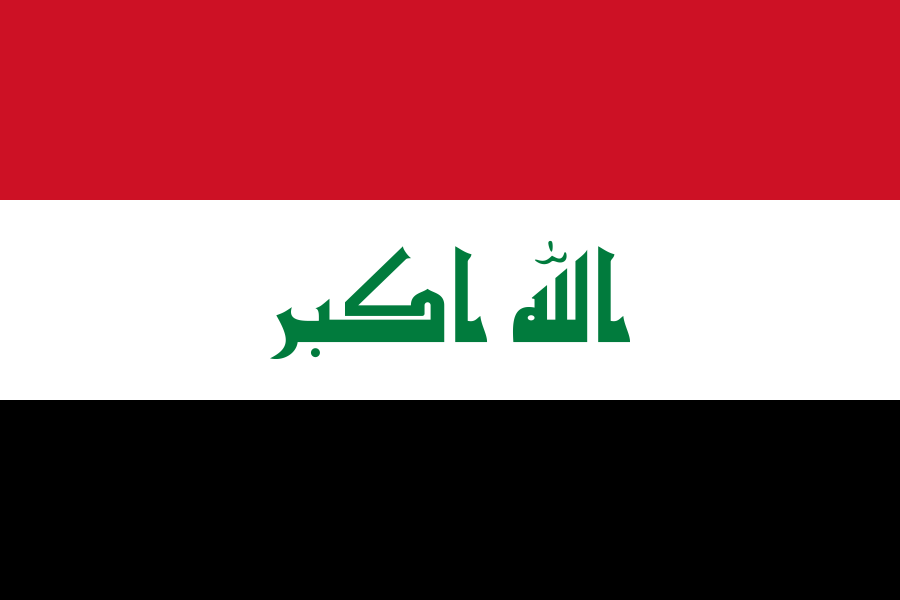
Entdecken Sie die beliebtesten Attraktionen, Wahrzeichen und Sehenswürdigkeiten in Irak.
36 Orte zu besuchen
AccomodationsThe Baghdad Hotel is a large hotel in Baghdad, Iraq, favored by Westerners after the 2003 invasion of Iraq. The hotel overlooks the Tigris on its eastern bank.
Auf Wikipedia lesen Religious Site
The Roman Catholic Archdiocese of Baghdad (Latin: Bagdathen(sis) Latinorum) is a Catholic diocese of the Roman/Latin Rite located in the city of Baghdad in Iraq. It has jurisdiction over three parishes of 2,500 Latin Church Catholics who live throughout Iraq.
Auf Wikipedia lesen Religious Site
The St. Joseph's Cathedral (Arabic: كاتدرائية القديس يوسف) or Latin Cathedral of St. Joseph is a Catholic cathedral located in Baghdad, the capital of Iraq.Because it is in the jurisdiction of the Latin Church, it is sometimes called the Latin Cathedral of St.
Auf Wikipedia lesen Historic
Freedom Monument (or Nasb al-Hurriyah) (Arabic: نصب الحرية), located in Tahrir Square (Liberation Square) in the centre of Baghdad, is the city's most well-known and well-loved monument.
Auf Wikipedia lesen Religious Site
The Al-Khilani Mosque (Arabic: جامع الخلاني) is a historic Shi'ite Islamic mosque located in Baghdad, Iraq.The date of the mosque's construction is unknown, however the oldest record of the mosque is the mention by Mustafa bin Kamal al-Din al-Sadiq al-Damashq in his travel diary to Bag…
Auf Wikipedia lesen Historic
Sir Sassoon Eskell, KBE (_ساسون حسقيل or ساسون حزقيال, 17 March 1860 – 31 August 1932) was an Iraqi statesman and financier. Also known as Sassoon Effendi (from Turkish Effendi, a title meaning Lord), he was regarded in Iraq as the Father of Parliament.
Auf Wikipedia lesen Historic
The Behistun Inscription (also Bisotun, Bistun or Bisutun; Persian: بیستون, Old Persian: Bagastana, meaning "the place of god") is a multilingual inscription and large rock relief on a cliff at Mount Behistun in the Kermanshah Province of Iran, near the city of Kermanshah in western Iran, e…
Auf Wikipedia lesen Other
OtherCultural Landscape of Hawraman or Cultural Landscape of Uramanat is the 26th tangible cultural heritage of Iran. This remote and mountainous landscape bears testimony to the traditional culture of the Hawrami people, an agropastoral Kurdish tribe that has inhabited the region since about 3000 BCE.
Auf Wikipedia lesen Settlements
Nippur (Sumerian: Nibru, often logographically recorded as 𒂗𒆤𒆠, EN.LÍLKI, "Enlil City;" Akkadian: Nibbur) was an ancient Sumerian city. It was the special seat of the worship of the Sumerian god Enlil, the "Lord Wind", ruler of the cosmos, subject to An alone.
Auf Wikipedia lesen Religious Site
The Al-Wazeer Mosque (Arabic: جامع الوزير) is an old mosque in Baghdad, Iraq which considered a cultural heritage. The mosque was built by the Wazir of Baghdad Hasan Pasha in 1660 during the Ottoman era. Later the mosque had witnessed several renovation and restoration works.
Auf Wikipedia lesen Religious Site
The Mosque-Madrasa of Al-Asifyah (Arabic: مدرسة الآصفية) is a complex of mosque and madrasa located near the riverbank of Tigris, in Baghdad, Iraq.
Auf Wikipedia lesen Religious Site
The Said Sultan Ali Mosque (Arabic: جامع سيد سلطان علي) is a mosque in Baghdad, Iraq. It is among the cultural heritages of the city, located at the southern part of the historical neighborhood of Rusafa at Al Rasheed Street, near the Al-Ahrar bridge, adjacent to the Tigris.
Auf Wikipedia lesen Architecture
 Architecture
The Shah Abbasi Caravansarai is a historical caravanserai located in Bisotun in Kermanshah Province, Iran. This caravanserai was listed as an Iranian national heritage on August 4, 1974. The caravanserai of Bisotun was constructed by order of Shah Abbas I.
Auf Wikipedia lesen Other
OtherThe Farhād Tarāsh, or Tarāsh-e Farhād is a long smoothed rock surface on Mount Behistun in western Iran. Located near the famous Behistun Inscription, its height is around 30 meters and its width is around 200 meters. The retaining wall in front of it is c. 150 meters.
Auf Wikipedia lesen Historic
The Statue of Hercules in Behistun (or Statue of Heracles/Herakles in Bisotun, Persian: تندیس هرکول) is located on Mount Behistun, Iran.
Auf Wikipedia lesen Mountain peaks
Mount Bisotoun (or Behistun and Bisotun) is a mountain of the Zagros Mountains range, located in Kermanshah Province of western Iran.
Auf Wikipedia lesen Historic
Ganj Dareh (Persian: تپه گنج دره; "Treasure Valley" in Persian, or "Treasure Valley Hill" if tepe/tappeh (hill) is appended to the name) is a Neolithic settlement in western Iran.
Auf Wikipedia lesen Historic
The Essaqwand Rock Tombs (Persian: گوردخمه اسحاقوند) are three rock-hewn tombs located 25 km southwest of Harsin in Kermanshah Province, Iran. On top of the middle tomb there is a rock relief of a man with his profile toward the viewers.
Auf Wikipedia lesen Historic
Sorkh Deh chamber tomb is a Shaft and chamber tomb type grave located in Kermanshah Province in Iran. Sorkh Deh in Persian means Red Village. The grave probably dates back 2500 years.
Auf Wikipedia lesen Settlements
Hatra was an ancient city in Upper Mesopotamia located in present-day eastern Nineveh Governorate in northern Iraq. The city lies 290 km (180 mi) northwest of Baghdad and 110 km (68 mi) southwest of Mosul.Hatra was a strongly fortified caravan city and capital of the small Arab Kingdom of Hatra, loc…
Auf Wikipedia lesen Religious Site
Tekyeh Biglarbeygi is a Tekyeh located in Kermanshah. this construction is well known for unique mirror decoration. Tekyeh Biglarbeygi was made during Qajar dynasty by efforts of Abdullah khan Biglarbeygi.
Auf Wikipedia lesen Religious Site
The Emad o dolah Mosque is related to the Qajar dynasty and is located in Kermanshah.
Auf Wikipedia lesen Historic
Dekhmeye Rawansar or Koshk (دخمه روانسر) is a rock-cut tomb located near the town of Ravansar, about 57 km northwest of Kermanshah, at west of Iran. This tomb was known to Ernst Herzfeld but he never visited it.
Auf Wikipedia lesen Settlements
Aššur (; Sumerian: 𒀭𒊹𒆠 AN.ŠAR2KI, Assyrian cuneiform: Aš-šurKI, "City of God Aššur"; Syriac: ܐܫܘܪ Āšūr; Old Persian 𐎠𐎰𐎢𐎼 Aθur, Persian: آشور: Āšūr; Hebrew: אַשּׁוּר, Aššûr, Arabic: اشور), also known as Ashur and Qal'at Sherqat, wa…
Auf Wikipedia lesen Cemeteries
Wadi-al-Salaam (Arabic: وادي السلام, romanized: Wādī al-Salām, lit. 'Valley of Peace') is an Islamic cemetery, located in the Shia holy city of Najaf, Iraq. It is the largest cemetery in the world.
Auf Wikipedia lesen Settlements
Samarra (Arabic: سَامَرَّاء, Sāmarrāʾ) is a city in Iraq. It stands on the east bank of the Tigris in the Saladin Governorate, 125 kilometers (78 mi) north of Baghdad. In 2003 the city had an estimated population of 348,700.
Auf Wikipedia lesen Architecture
The Fortress of Al-Ukhaidir (Arabic: حصن الأخيضر) or Abbasid palace of Ukhaider is located roughly 50 km south of Karbala, Iraq. It is a large, rectangular fortress erected in 775 AD with a unique defensive style.
Auf Wikipedia lesen Religious Site
Ezekiel's Tomb, located in Al Kifl, Iraq, is believed by Jews and Muslims to be the tomb of the biblical prophet Ezekiel. While the site is the oldest and most important Jewish religious site in Iraq; today it forms part of the Al-Nukhailah Mosque complex.
Auf Wikipedia lesen Palaces
Babylon was the ancient city where some of the most influential empires of the ancient world ruled. It was the capital of the Babylonian Empire and it was considered to be a center of commerce, art, and learning and is estimated to have been the largest early city in the world, perhaps the first to…
Auf Wikipedia lesen Religious Site
Tekyeh Moaven al-molk (Persian:تکیه معاون الملک) is a Tekyeh and historical place located in Kermanshah city of Iran. It was built during Qajar era as a Shia mourning site. On 1 December 1975 Tekyeh Moaven al-molk was recognized as National monument of Iran.
Auf Wikipedia lesen Religious Site
Haj Shahbazkhan Mosque (or Haj Shahbaz Khan Mosque; Persian: مسجد حاج شهبازخان) is a mosque located in the Ojagh Crossroads of Kermanshah, Iran.
Auf Wikipedia lesen Religious Site
Pentecostal church in kermanshah is an Assyrian Pentecostal Church in Kermanshah city of Iran.
Auf Wikipedia lesenDarreh Shahr Ancient City, also known as Madaktu and Seymareh, is the name of a 200 hectares (490 acres) ruined area next to the existing city of Darreh Shahr in southwest Iran, in Ilam Province.
Auf Wikipedia lesenSacred Heart of Jesus Church is an old church in Kermanshah. this church made by order of Bishop Johannanyan in 1914. on August 7, 2004 registered as Iranian national heritage with 11059 registration number.
Auf Wikipedia lesenQasr-e Shirin (Persian: قصرشيرين; also Romanized as Qaşr-e Shīrīn and Qasr-ī-Shīrīn; also known as Ghasr-ī-shīrīn and Ghasr-shīrīn, Kurdish: قەسری شیرین) is a city and capital of Qasr-e Shirin County, Kermanshah Province, Iran.
Auf Wikipedia lesenIraq, officially the Republic of Iraq, is a country in West Asia. Located within the Middle East, it is bordered by Saudi Arabia to the south, Turkey to the north, Iran to the east, the Persian Gulf and Kuwait to the southeast, Jordan to the southwest, and Syria to the west. The country covers an area of 438,317 square kilometres (169,235 sq mi) and has a population of over 46 million, making it the 58th largest country by area and the 31st most populous in the world.
Auf Wikipedia lesenBleiben Sie verbunden mit einem günstigen eSIM-Tarif — sofortige Aktivierung, keine Roaming-Gebühren.
eSIM-Tarife für Irak ansehenDaten von OpenTripMap & OpenStreetMap